
What Are the Steps in AML Checks When Onboarding Clients as Accountants
Discover the key steps in AML checks accountants must follow when onboarding clients, from identity verification to ongoing due diligence.
Every accountant must follow strict Anti-Money Laundering (AML) checks before onboarding clients. Here's a simple breakdown of the steps you can't miss.
Failure to comply with AML requirements can lead to hefty fines, serious reputational damage and even criminal prosecution.
It's no wonder AML checks are risky, and getting them wrong can be costly. But the process is overwhelming with dozens of requirements from CDD and EDD to risk assessments, document verification and watchlist screening. It's so confusing about where to start.
If you are in the same dilemma, don't worry. As an accountant, we've been there and with years of AML onboarding experience, we've learned the most effective way to fulfil these requirements.
In this blog post, we'll walk you through seven essential steps in AML onboarding that will give you a clear framework to follow. Plus, we've a bonus tip at the end that can handle all your AML and KYC checks in minutes.
Sounds fair? Let's get started with step no 1.
Step 1: Identify the Client (Customer Due Diligence)

The first step in AML onboarding is identifying your client through Customer Due Diligence (CDD).
For this, you need to collect proof of identity and proof of address from both the businesses and the individuals. Some of the documents you can collect include:
| For Individuals | For Businesses |
|---|---|
| Proof of identity (passport, driver's license) | Corporate structure details and information about beneficial owners |
| Proof of address (utility bills, bank statements) | Incorporation documents |
Accuracy and completeness of this information are crucial for knowing exactly who you are dealing with, and any missing or incorrect information can create compliance gaps and potential regulatory issues.
Mini tip:
Use digital forms to collect client details and request verified documents upfront. This saves time, speeds up client onboarding, reduces errors, and gives a clean audit trail from day one.
Step 2: Verify the Client's Identity

Collecting documents from the client is not enough. You need to confirm that the documents are genuine and the client is who they claim to be.
For this, you need to cross-check official identification documents with trusted databases like the UK Passport Office, Death Registers, Credit Reference Agencies, and DVLA (Driver and Vehicle Licensing Agency) for individuals. For Businesses, you need to verify incorporation and ownership details via Companies House or equivalent registries.
Using online verification tools can speed up these checks. But always make sure to add a final manual review as an extra layer of assurance. It not only protects your firm from hidden risks but also demonstrates your AML process is robust and reliable.
Step 3: Assess Client Risk (Risk-Based Approach)
Not all clients carry the same level of risk. A risk-based approach ensures that resources are focused where they're needed most.
Assess clients based on factors such as client type (individual vs. corporate), country of residence, transaction patterns, and source of funds. Clients associated with high-risk countries or industries should receive extra checks.
Once assessed, categorise clients as low, medium, or high risk. This categorisation determines the level of monitoring, verification, and due diligence needed throughout the business relationship.
This method enables you to make efficient use of resources while still complying with AML requirements.
Step 4: Perform Enhanced Due Diligence (EDD) for High-Risk Clients

For clients flagged as high risk, perform Enhanced Due Diligence (EDD).
This requires you to go beyond standard CDD and carry out additional checks, such as verifying the source of funds, checking if the client is a Potentially Exposed Person (PEP), and obtaining senior management approval before onboarding.
EDD helps to detect risks that may not be apparent during standard checks. It also minimises both regulatory and reputational exposure while ensuring your firm is regulatorily compliant.
Step 5: Screen Against Sanctions & Watchlists

As an accountant, you could be held a partner in crime even if you unknowingly work with individuals or entities involved in illegal activities. That's why it is crucial to screen clients against sanctions and watchlists.
For this, you need to check official resources such as HM Treasury sanctions, UN sanctions, and other relevant global watchlists, and document the results carefully to maintain a clear audit trail.
It may sound like a lot of hassle, but AML software like FigsFlow (more on that at the end) can help you ensure AML compliance in under 60 seconds. It saves time, reduces errors, and provides immediate alerts if a match is found.
Step 6: Record Keeping

You are legally required to keep records of all checks and documents for at least five years from the end of the business relationship.
This means every document collected during CDD, EDD, and throughout your AML process, such as proof of address, identification documents, corporate records, risk assessments, verification checks, and approvals, must be properly stored.
These records and audit trail act as your defence in the event of a regulatory inquiry. Regulators will look for evidence of compliance, and you need to demonstrate that sufficient checks were carried out and documented.
Step 7: Ongoing Monitoring

AML compliance is not a one-time activity. It requires ongoing monitoring to ensure client information stays accurate and suspicious activities are detected quickly.
So, as an accountant, you must review clients' transactions, update client information, and flag unusual activity for further investigation. In case of high-risk clients, you should perform periodic checks of their profiles and transactions and, if needed, file Suspicious Activity Reports (SARs).
Ongoing monitoring protects your firm from emerging risks and maintains trust with clients and stakeholders. Plus, it forms a key part of your proactive AML strategy.
Simplify Your AML Onboarding with FigsFlow
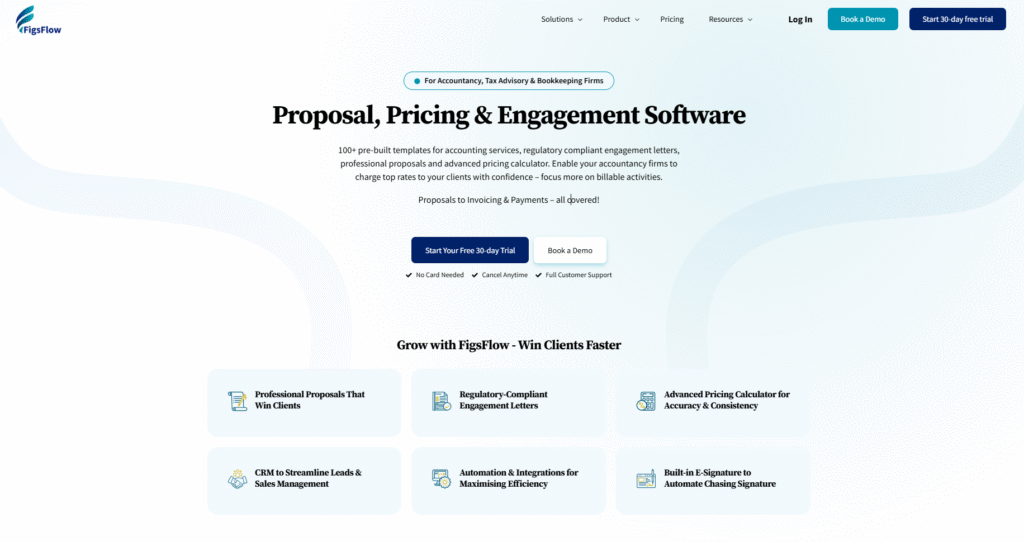
FigsFlow, includes complete AML checks within its proposal, pricing and engagement platform, making it the first truly all-in-one onboarding solution for accountants.
KYC, CDD and [[aml-software-for-accountants|AML checks]] all happen within a single platform, making regulatory compliance faster, easier and more efficient than ever before.
Here's how FigsFlow simplifies your AML onboarding:
- Verify client identities digitally using industry standard technology that checks documents against comprehensive databases
- Screen clients automatically against global sanctions lists, PEP databases and adverse media
- Automate risk assessments and client categorisation using purpose-built templates designed for accounting practices
- Support Enhanced Due Diligence (EDD) for high-risk clients with scheduled automated checks at custom intervals
- Maintain comprehensive records with automatic audit trails and timestamps for every compliance action
FigsFlow handles your complete client journey from proposals and engagement letters to full AML compliance in one accountant-centric workflow. And all this comes at a price you'd have never imagined, making FigsFlow the perfect fit for practices that want everything they need in one place. It's the most affordable and reliable AML solution in the market, yet simple enough for anyone on your team to use from day one.
Ready to transform your AML onboarding? Try FigsFlow free for 30 days and experience the complete solution.
Conclusion
There's a lot of noise around AML checks, and while it may seem like a complicated process, it's quite the opposite.
With a well-defined framework and structured process, you can easily and affordably stay compliant with the latest AML requirements.
You can start by identifying your clients and verifying their identities, then assessing their risk based on specific parameters. Perform the necessary checks and follow-up processes according to their risk profile.
For a practical, step-by-step walkthrough, check out our next guide on: How to complete KYC in minutes, where we share the fast-track KYC process we use at our firm.
Run your firm on one platform
Proposals, engagement letters, pricing and AML — built for ACCA, ICAEW, ATT, CIOT, AAT and CIMA firms.